
Pinot gris
White grape variety
Origin
This variety corresponds to the gray mutation of Pinot Noir. It is quite common to find variations towards the white form on the same vine, but much rarer towards the black form.
Synonyms
In the European Union, Pinot Gris is officially known by other names: Grauer Burgunder (Austria), Pinot Grigio (Italy), Ruländer (Germany, Austria, Netherlands), Rulandské šedé (Czech Republic, Slovakia), Sivi Pinot (Slovenia), and Szürkebarát (Hungary).
Phenology
- Budburst period: 2 days after the Chasselas variety.
- Ripening period: Period 1, 1 and a half weeks after the Chasselas variety.
Technological potential
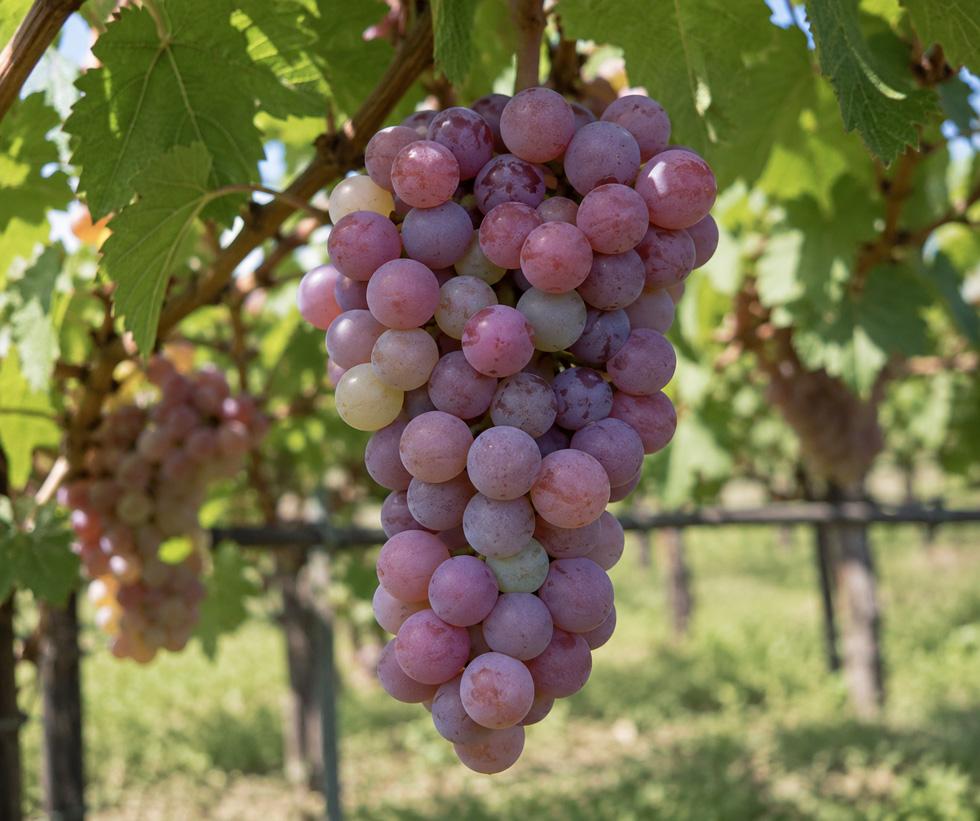
The clusters and berries are small or very small in size. Pinot Gris allows for the production of wines of great finesse, very powerful, robust, and aromatic. The sugar accumulation potential is high in this variety, with low to moderate acidity. Wines obtained from Pinot Gris usually present an intense yellow color and have specific aromas that are distinct from Pinot Blanc.
Agronomic characteristics
- Pinot Gris is a fairly vigorous but low-yielding variety.
- It adapts particularly well to northern regions, to sufficiently deep, relatively dry, and well-exposed calcareous soils.
- It is not very sensitive to winter cold, and its fruit yield is usually optimal after a spring frost.
If you are interested in a specific clone or rootstock
Request a quote
"*" indicates required fields