
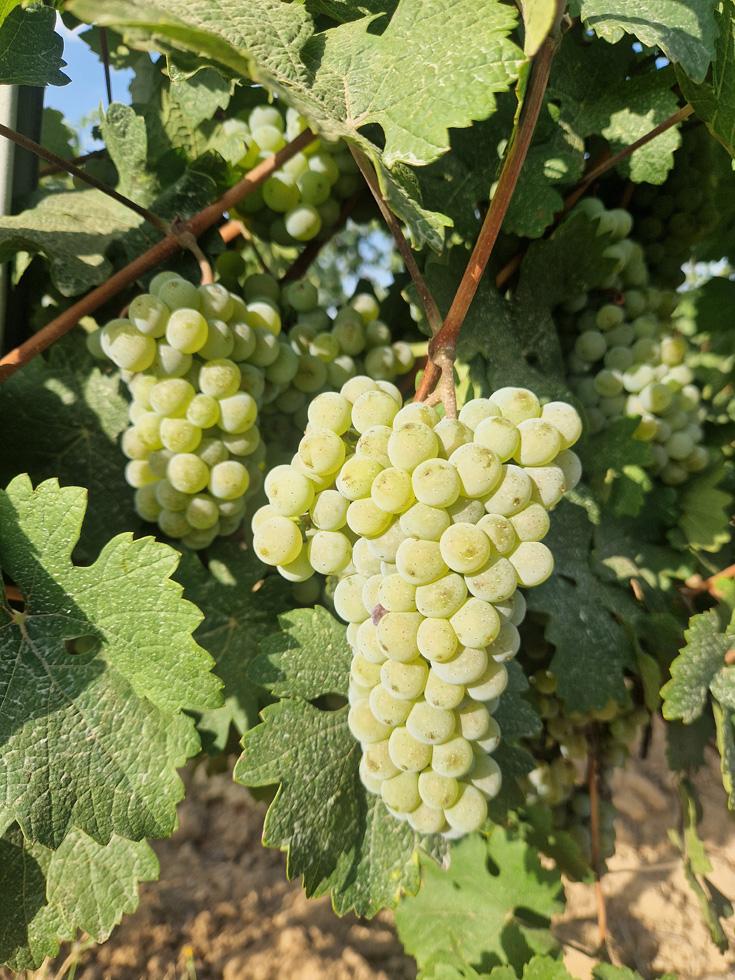
Riesling
White grape variety
Origin
This variety, probably originating from the banks of the Rhine, is, according to published genetic analyses, a possible descendant of Gouais Blanc.
Synonyms
In the European Union, Riesling is officially known by other names: Rajnai rizling (Hungary), Renski rizling (Slovenia), Rhine Riesling (Cyprus), renano (Italy), Rizling rýnsky (Czech Republic, Slovakia), and Weißer Riesling (Germany, Austria).
Phenology
- Budbreak period: 5 days after the Chasselas variety.
- Ripening period: 2nd period, 3 weeks after the Chasselas variety.
Technological potential
The clusters and berries are small in size. Riesling allows for the production of high-quality, very aromatic, lively, and elegant dry white wines. The acid balance of these wines is high. They have aging potential, and their aromas can slowly evolve towards 'petrol' notes (hydrocarbons). When harvested with excess ripeness or in the presence of noble rot, Riesling can produce excellent dessert wines.
Agronomic characteristics
- Riesling tolerates cold winters well, and its fruit yield is usually optimal after a spring frost.
- This variety should be trained with long pruning and trellised.
- It is somewhat susceptible to rachis drying.
- It thrives in all types of soil (calcareous, with granite), but predominantly schist composition.
If you are interested in a specific clone or rootstock
Request a quote
"*" indicates required fields