
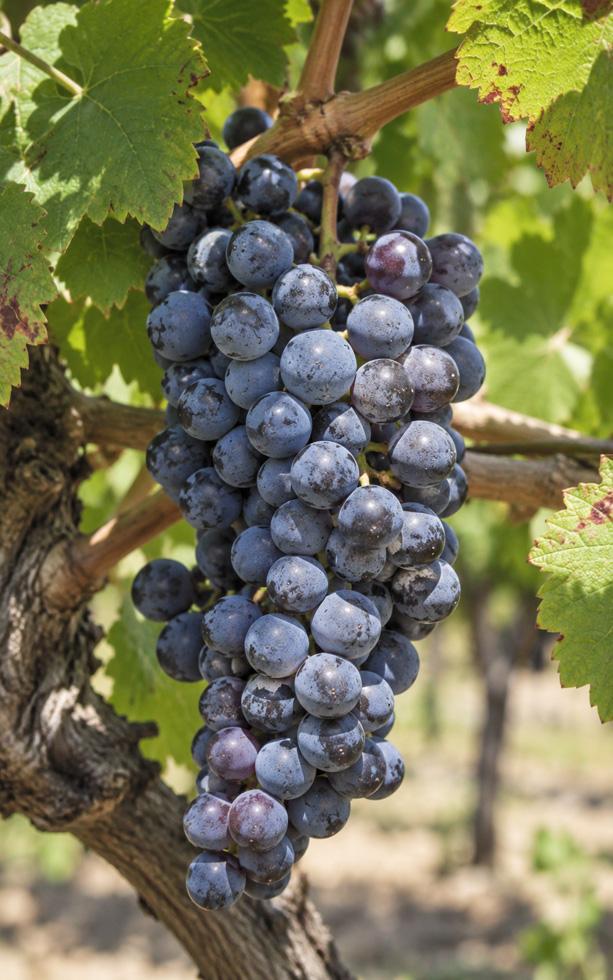
Carignan
Black grape variety
Origin
This variety is of Spanish origin (probably from the Aragon region).
Synonyms
In Spain, Carignan is officially called “Mazuela”.
Phenology
- Budbreak period: 9 days after the Chasselas variety.
- Ripening period: Late ripening, 4 and a half weeks after the Chasselas variety.
Technological potential
The bunches and berries are medium to large in size. Carignan has medium potential in terms of sugar content and high potential in terms of color. However, the tannins are often harsh, herbaceous, and bitter, and the resulting wines lack fruitiness and softness; these characteristics can be optimally corrected with carbonic maceration. In fact, this is usually related to the age of the vines, production conditions, and soil. Indeed, in a less fertile area, on quality soils, with mature vines and limited production, the resulting wines can be powerful and generous.
Agronomic characteristics
- Carignan exhibits a semi-erect growth habit.
- It is a fertile variety that allows for regular, often significant, production.
- It is easy to manage and can be pruned short (goblet, cordon).
- Carignan adapts well to warm, dry regions and less fertile soils (schist, for example).
- It also shows good adaptation to very windy areas.
- Regarding mineral nutrition, Carignan sometimes shows sensitivity to potassium deficiency.
If you are interested in a specific clone or rootstock
Request a quote
"*" indicates required fields